
Why England's 2026 World Cup Squad Sticks Two Fingers Up At Nigel Farage's Immigration Policy

England’s 2026 World Cup squad showcases the benefits of an open, multicultural society, directly challenging Nigel Farage’s anti-immigration rhetoric. Built on the diverse backgrounds of players whose families migrated from Africa, the Caribbean, Ireland, and beyond, the team illustrates that inclusion strengthens national identity and sporting achievement. The squad’s excellence is a testament to the positive impact of immigration, suggesting that policies embracing diversity yield advantages—both on and off the field—contradicting calls for stricter border controls.
- England's World Cup squad thrives on multicultural, migrant backgrounds.
- Farage’s anti-immigration vision would weaken the national team.
- Diversity is England’s competitive advantage on the global stage.
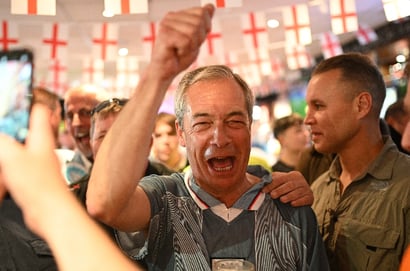
Nigel Farage wants a Britain that tightens its borders, looks inward and treats immigration as a problem to be solved. England’s 2026 World Cup squad is living proof that the opposite is true.
The country’s biggest sporting asset - the Three Lions - is built on migrant roots and multicultural streets, not nativist nostalgia. Yet no doubt Farage will be backing England's squad for the 2026 World Cup.
When Farage’s Britain Meets Tuchel’s England
Thomas Tuchel’s 26‑man squad touch down in the United States as one of the favourites for the World Cup, carrying the flag into a tournament co‑hosted by three immigrant nations built on movement and mixing.
In the official launch videos and training‑ground clips you see the modern face of England in microcosm: Jude Bellingham laughing with Bukayo Saka, Kobbie Mainoo zipping passes into Harry Kane, Marcus Rashford and Ivan Toney trading finishing drills under the Miami sun.
Back home, Nigel Farage’s Reform UK has spent the last year pushing an immigration platform that promises to slam many of the doors that created those stories.
The party’s proposals hinge on “taking back control of our borders”, reviewing and revoking immigration status on a mass scale, and making it far harder for families to put down roots in Britain. The implied ideal is a smaller, whiter, more homogenous England - something closer to 1966 than 2026.
Place that vision next to the team in white shirts and it falls apart.
The Squad Immigration Built
Look down the England team sheet for 2026 and the breadth of family journeys jumps off the page.
In attack and midfield, some of the team’s brightest stars are the children of African and Caribbean migration.
Bukayo Saka, born in Ealing, is the son of Yoruba Nigerian parents who came to Britain and raised their family in west London. Eberechi Eze and Noni Madueke share similar stories, both London‑born with Igbo Nigerian heritage.
Kobbie Mainoo is a Stockport local whose parents are from Ghana, part of a Ghanaian diaspora that has put down deep roots in English towns and cities.
On the defensive side, Ezri Konsa represents Newham but also something wider. He was born in east London to a father from DR Congo and a mother from Angola, part of the African communities that have transformed the east end over recent decades.
Tino Livramento’s background traces a different route: Croydon‑born, with a Portuguese father and Scottish mother, linking England to both southern Europe and the Celtic fringe.
Then there is the Caribbean line. Marcus Rashford grew up in Manchester but has spoken about his maternal grandmother being born on Saint Kitts, and has paternal Jamaican descent in his family tree.
Ivan Toney is English‑born with Jamaican heritage through his mother and Vincentian descent via his father. Ollie Watkins is Torquay‑born but widely reported as having Jamaican ancestry, even if the public record is sketchier on the precise branch of the family tree.
Layer on top of that the Irish and Celtic connections that have been threaded through English football for generations.
Harry Kane was born in Leytonstone but his father, Patrick, was born in Galway. Declan Rice grew up in Kingston‑upon‑Thames yet has paternal grandparents from Douglas, County Cork, which is how he was able to represent the Republic of Ireland before switching allegiance to England.
Reece James has Grenadian and Dominican descent via his father as well as English heritage through his mother. Jarell Quansah, raised in Warrington, has Scottish, Ghanaian and Barbadian heritage through his grandparents.
None of these players is a token diversity pick. They are core: Saka and Bellingham as creative heartbeat, Mainoo as the metronome in midfield, Rashford and Toney as goal threats, Kane as the captain and reference point up front.
Without their families’ decisions to move and stay, this squad looks radically different - and almost certainly weaker.
Set against them are the players with only English parentage and ancestry: keepers like Jordan Pickford and Dean Henderson, defenders John Stones and Dan Burn.
The strength of this team is not in being one thing or the other; it is in being both at once - a blend of long‑settled English families and relatively recent arrivals, mixing accents, cultures and styles.
Farage’s Immigration Plan vs The Three Lions
Reform UK’s platform, as Farage has sketched it out, is built on a simple premise: Britain has admitted too many people, too quickly, and must now reverse course.
The party talks about cancelling what it casts as a “Boris wave” of migration, tightening family reunion, and ending what it describes as “automatic” settlement in favour of precarious, renewable visas.
It has floated the idea of reviewing all asylum decisions from recent years and deporting many of those whose claims were accepted, and proposes the creation of a US‑style enforcement body to oversee removals on a huge scale.
In that worldview, migration is primarily a threat to public services, to culture, to an imagined core of “Britishness”. Yet the lives behind England’s 2026 squad show the other side of the ledger - the one that rarely makes Farage’s stump speeches.
If parents like those of Saka, Eze, Madueke and Mainoo had never been able to settle and build lives in England, if families like Rashford’s grandmother or Toney’s parents had found the door slammed shut, the Three Lions would not have this particular mix of talent to choose from.
If their presence had been treated as a temporary exception, constantly up for review, rather than something to stabilise and integrate, many of these players might have grown up elsewhere or identified with a different flag.
There is a counterfactual England that Farage rarely talks about: a national team stripped of a huge chunk of its star power, because the underlying policies he favours over decades would have made those family stories less likely or pushed them to blossom under different colours.
Immigration as Competitive Advantage
For all the hand‑wringing about immigration in political debate, elite football has quietly shown what a more honest balance sheet looks like.
England’s talent pipeline in 2026 runs through London, Birmingham, Manchester and other urban hubs where migrant communities are concentrated.
Grassroots clubs in those areas draw from kids whose parents came from Nigeria, Ghana, DR Congo, Angola, Jamaica, Saint Kitts and Nevis, Ireland, Portugal, Grenada, Dominica and countless other places.
When those children come through Premier League academies, England suddenly has to fight off competition from the FAs of their parents’ and grandparents’ homelands.
We have already seen Nigeria and Ghana actively courting England‑reared players, and Ireland lose high‑profile prospects like Rice. The battles around dual‑eligible players are now an entrenched part of the international game.
England’s current depth owes a lot to the fact that, so far, many of those players have felt English enough - and settled enough - to choose the Three Lions.
It is hard to imagine that happening in a country whose governing mood towards their families was suspicion and hostility.
Welcoming migrants, giving them security and a fair shot, and allowing their children to grow up feeling like they belong does not just produce feel‑good stories; it produces better footballers.
In the language Farage claims to prize - cold self‑interest - immigration has become a competitive advantage.
Who Owns Englishness Now?
Beyond the spreadsheets, there is symbolism. For years, the national team has been one of the few spaces where a more expansive idea of Englishness has begun to feel normal.
Fans who might disagree furiously about politics stand side by side in replica shirts with “Saka” on the back, or scream themselves hoarse when a kid with Ghanaian parents and a Stockport postcode glides through midfield in a World Cup quarter‑final.
The flag that Farage wraps himself in is the same one around the shoulders of players whose families, under his preferred system, might never have been here long enough to feel that it was theirs.
The anthem he claims to defend is sung by men whose bloodlines and backstories make a nonsense of the idea that there is one “real” England that everyone else must defer to.
None of this means football can or should dictate immigration policy. Tax receipts and asylum statistics do not hinge on whether a winger goes past his full‑back.
But the national team is a mirror, and in 2026 it reflects a country that is already irreversibly mixed: ethnically, culturally, generationally.
To insist that this England is somehow less authentic than the one in Farage’s speeches is to tell Saka, Mainoo, Rashford, Kane, Konsa, Eze, Madueke, Toney and the rest that their claim to the shirt is conditional. Most supporters have already rejected that idea by their behaviour, if not their words.
So when Tuchel’s players walk out in the United States this summer, it will not just be eleven men on a pitch. It will be a roll‑call of migrant journeys and local loyalties that quietly, firmly contradict Nigel Farage’s story about who belongs here and why.
In that sense, every goal this team scores is not just for England as he imagines it - it is for the England that exists, the one that would not be half as good without the very immigration he wants to end.

Conrad is a seasoned journalist with a Bachelor's Degree in Journalism from the The Missouri School of Journalism. He kickstarted his career as a freelance contributor for CardPlayer Magazine, where he honed his skills in covering local events and dissecting online poker legislation. Rising through the ranks, Mark joined Bluff Magazine as a Staff Writer. At Bluff, he specialized in covering high-stakes tournaments like the World Series of Poker (WSOP) and the World Poker Tour (WPT), while also delivering compelling interviews with professional players.
Conrad also covers sports betting and enjoys going to Kansas City Chiefs games.
Top Betting Sites
Betting offers
Upcoming Events
21 September 2026
- EMEA Masters 2026 Summer -
- Esports
24 September 2026
- VALORANT Champions 2026 -
- Esports
- EuroLeague 2026/27 -
- Basketball
28 September 2026
- WTA Beijing -
- Tennis
Load More
Today's Acca Tips
-
Soccer tips
-
Horse Racing tips
-
Tennis tips


