
Why Hugo Broos May Need to Rethink South Africa's Defensive Approach Against Czechia

South Africa enters their second Group A World Cup match against the Czech Republic in dire need of a turnaround following a 2-0 loss to Mexico and suspensions to key midfielders Zwane and Sithole. The tactical preview highlights South Africa's vulnerability to the Czechs' superior aerial strength, especially on set pieces, due to their traditional zonal marking system. To avoid being overpowered, Bafana Bafana must shift to aggressive man-marking, disrupting Czech set pieces with physical blocking and early contact. This strategy is crucial for South Africa’s hope of containing their opponents and staying in the tournament.
- South Africa must abandon zonal marking to counter Czech Republic’s aerial advantage.
- Aggressive man-marking and early physical disruption are key tactical recommendations.
- This urgent shift is crucial to keep Bafana Bafana’s World Cup hopes alive.
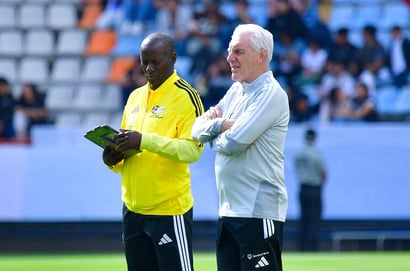
South Africa battle the Czech Republic in their second Group A fixture at the ongoing FIFA World Cup as they look to bounce back from a bruising 2-0 defeat to Mexico on the opening day.
Following that disappointing performance, the result leaves Bafana Bafana staring down a structural and physical crisis.
The betting preview markets are heavily fixated on the disciplinary fallout of matchday one. The catastrophic losses of veteran midfield Themba Zwane and holding anchor Sphephelo Sithole to direct red cards.
However, the hidden tactical blueprint that will decide this match has nothing to do with open-play possession retention. It lies in a terrifying aerial disparity that Hugo Broos must urgently address.
South Africa must not rely on their traditional, passive zonal marking schemes during dead-ball routines. Doing that could see the Czech Republic completely dominate Bafana Bafana in the air.
The Geometry of the Deficit
South Africa's defensive identity under Broos is built for ground-level mobility, lateral interception speed, and rapid transitional sweeping.
Center-backs like Ime Okon and Mbekezeli Mbokazi thrive when defending grass but seem to struggle when forced into vertical, stationary aerial duels.
The Czech Republic’s expected starting line-up presents a towering wall of continuous height across every single phase of the pitch.
From the defensive base of captain Ladislav Krejčí (1.91m) and Robin Hranáč (1.90m) to the midfield anvil of Tomáš Souček (1.92m) and Bayer Leverkusen talisman Patrik Schick (1.91m), Miroslav Koubek's 3-4-2-1 structure is engineered to weaponize the aerial presence of the team.
Against a standard zonal marking team, which assigns territory to defenders rather than specific bodies, the Czechs do not need to win clean headers on initial distributions.
Their game plan relies on producing mass physical leverage, overloading the near post, and utilizing secondary knockdowns to generate chances inside the six-yard box.
The Midfield Disconnection Trap
Worsening this aerial vulnerability is the total structural isolation of South Africa's remaining midfield pillar, Teboho Mokoena. With Sithole suspended, Mokoena loses his primary physical foil in the double-pivot.
Koubek’s set-up will look to exploit this immediately. Czech Republic’s advanced playmaking duo of Pavel Šulc and Lukáš Provod is likely to deploy a suffocating, three-second counter-press directly on Mokoena the instant possession flips.
If Mokoena is pressed into turning backward or executing rushed clearances, he plays directly into the Czech trap.
Krejčí will comfortably claim those balls at the halfway line, instantly recycling them into high, wide positions and ultimately creating looping crosses back over a retreating, vertically outmatched South African defense.
The Strategic Antidote - Disruptive Man-Marking
To avoid absolute aerial domination in Atlanta, Broos has no choice but to completely tear up his traditional defensive handbook. Zonal structures rely on cohesive timing, which is a luxury this heavily reshuffled, suspended South African core simply does not possess.
Instead, Bafana Bafana must implement an aggressive, highly disruptive individual man-marking system coupled with explicit physical blocking shields.
Sacrificial runners like Jayden Adams must be instructed to make early, heavy physical contact with the Czech targets before the ball is even kicked.
By deliberately breaking up their running lines and forcing stationary, flat-footed jumps, South Africa can minimize the structural trajectory of the delivery.
This allows goalkeeper Ronwen Williams a fighting chance to slide out and claim cross distributions cleanly.
Surviving the Flight Path in Atlanta
Thursday's Group A clash between South Africa and the Czech Republic will determine whether tactical discipline can neutralize a severe aerial mismatch.
If South Africa relies on a passive zonal layout that allows the Czech Republic's towering icons a clean, unhindered run into the box, they risk being completely overpowered by a team custom-built for second-phase aerial destruction.
The true test for Hugo Broos' depleted squad lies in their physical aggression.
By enforcing an uncompromising individual man-marking regime and using early blocking shields, they may stand a genuine opportunity to rescue their World Cup campaign.
Top Betting Sites
Betting offers
Upcoming Events
28 May 2026
- CDL 2026 Stage 4 Major Qualifiers -
- Esports
06 June 2026
- VALORANT Masters London 2026 -
- Esports
10 June 2026
- Volleyball Nations League 2026 -
- Volleyball
Load More
Today's Acca Tips
-
Soccer tips
-
Horse Racing tips
-
Tennis tips


