The Machineseeker EHF Champions League is the strongest club handball competition in the world, and from 2026/27 it runs to a new 24-team format.
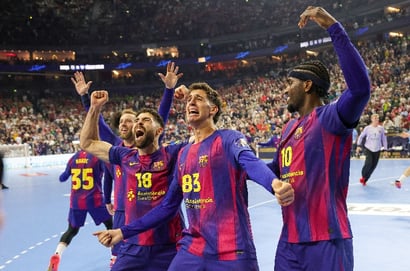
Barça are the reigning champions and the most decorated club in the competition's history. This guide covers the format, the calendar, the venues, the historical record and the markets that pay at each stage.
Competition at a Glance
Category
| Details
|
|---|
| Competition | Machineseeker EHF Champions League (men) |
| Group phase | Six groups of four, home and away, six matches per team |
| Main round | Two groups of six, eight matches per team |
| Quarter-finals | Two-legged, fixed pairings, no draw |
| FINAL4 | Single-match semi-finals, third-place match and final |
| Reigning champions | Barcelona (2025–26) |
| Most titles | Barcelona, 13 |
The 2026/27 Format in Full
The competition expanded from 16 teams to 24 for 2026/27, and any model built on the old two-group structure needs re-basing.
Group phase. Six groups of four, played home and away, so six matches per team. The top two in each group advance to the main round and carry their head-to-head result with them. Third and fourth transfer to the EHF European League play-offs.
Main round. Two groups of six. Each team plays home and away only against the four teams that arrived from the other two groups, giving eight matches. Positions one to four go to the quarter-finals, fifth drops into the European League Last 16, and sixth is eliminated.
Quarter-finals. Two-legged with fixed pairings and no draw: Group I first against Group II fourth, Group I second against Group II third, Group II second against Group I third, Group II first against Group I fourth. There is no country protection from the main round onwards.
FINAL4. Semi-finals are drawn by lot and played as single knockout matches, followed by the third-place match and the final.
Matches are two halves of 30 minutes with a 15-minute interval, scored two points for a win, one for a draw and none for a defeat. Squads are capped at 16 players and five officials. Only two draws take place across the whole season, for the group phase and the FINAL4.
Tie-breaks That Decide Bets
Group tie-breaks run in order: goal difference across all matches, then goals scored. Once the group is complete, the sequence adds head-to-head points, head-to-head goal difference, group goal difference, group goals scored, and finally a drawing of lots.
Two-legged quarter-finals settle differently, and this is the detail most bettors miss. No extra time is played. If both clubs finish level on points across the tie, it goes to aggregate goal difference and then straight to penalty throws — five nominated throwers alternating, followed by sudden-death rounds of five. There is no away-goals rule.
The 2025/26 quarter-finals produced the textbook case: Veszprém and Füchse Berlin finished 65-65 across two legs, and Berlin advanced 4-3 on penalties.
Cologne and the FINAL4
The FINAL4 is played at the LANXESS arena in Cologne. The 2026 edition, on 13 and 14 June, was the 17th time Cologne has hosted the event since it was inaugurated in 2010, and it drew a record 20,122 spectators. The 2027 edition returns to Cologne on 12 and 13 June.
The 2026 weekend ran as follows: Magdeburg 35-40 Füchse Berlin and Aalborg 32-37 Barça in the semi-finals, Magdeburg 32-26 Aalborg in the third-place match, and Barça 37-34 Füchse Berlin in the final.
A single-match semi-final drawn by lot is a materially different betting proposition from the two-legged rounds that precede it. There is no aggregate to manage, no second leg to hold players back for, and the neutral venue strips out the home advantage that carried teams through the group phase.
Calendar and Fixture Congestion
The 2026/27 calendar:
Stage
| Dates
|
|---|
| Group Phase | 9–10 September to 28–29 October 2026 |
| Main Round | 18–19 November 2026 to 3–4 March 2027 |
| Quarterfinals | 24–25 March and 31 March–1 April 2027 |
| FINAL 4 | 12–13 June 2027 |
The January gap is the international tournament window. Clubs supplying large national-team contingents lose those players for three weeks and get them back tired. Form immediately after the break rarely resembles form before it, and lines built on autumn data lag the reality on court in February.
Recent Champions
Season
| Champion
| Score
| Runner Up
|
|---|
| 2025–26 | Barcelona | 37-34 | Fuchse Berlin |
| 2024–25 | SC Magdeburg | 32-26 | Fuchse Berlin |
| 2023–24 | Barcelona | 31-30 | Aalborg |
| 2022–23 | SC Magdeburg | 30-29 | Kielce |
| 2021–22 | Barcelona | 37-35 | KIelce |
| 2020–21 | Barcelona | 36-23 | Aalborg |
| 2019–20 | THW Kiel | 33-28 | Barcelona |
All-time Title Winners
Club
| Titles
| Runner Up Finishes
|
|---|
| Barcelona | 13 | 5 |
| Gummersbach | 5 | 1 |
| SC Magdeburg | 5 | 0 |
| THW Kiel | 4 | 4 |
| Dukla Prague | 3 | 2 |
| Ciudad Real | 3 | 2 |
| SKA Minsk | 3 | 0 |
Barcelona's 13 titles came in 1991, 1996, 1997, 1998, 1999, 2000, 2005, 2011, 2015, 2021, 2022, 2024 and 2026.
The Clubs to Know
Barça play in Liga ASOBAL and won the 2025–26 double, taking Europe and finishing the Spanish season with 30 wins from 30. SC Magdeburg won the Handball-Bundesliga with 31 wins from 34, and Füchse Berlin finished as German runners-up and European runners-up. Aalborg Håndbold of Denmark completed the 2026 FINAL4 field.
Beyond that group, the Bundesliga's top six also featured SG Flensburg-Handewitt, VfL Gummersbach, THW Kiel and MT Melsungen. Paris Saint-Germain won a 13th French title ahead of HBC Nantes and Montpellier. Hungary's One Veszprém and Pick Szeged were 2025/26 quarter-finalists, and the wider field included Industria Kielce, Orlen Wisła Płock, GOG, RK Zagreb, Kolstad, Dinamo București and Eurofarm Pelister. Sporting CP and FC Porto entered for 2026/27.
The federations holding a fixed 2026/27 place are Germany, Spain, France, Denmark, Poland, Hungary, Romania, Portugal, Croatia and Norway, with a maximum of three clubs per federation. That list is the best available proxy for national league strength.
Betting the Competition Stage by Stage
Group phase. The highest-scoring handball on the calendar. The 2025–26 season produced 8,282 goals in 132 matches, an average of 62.74 per game — above the EURO, above every domestic league, and five goals clear of the competition's own ten-year average of 57.64. Home advantage carries weight here: Champions League home sides won 56.6% of matches over 1,669 games from 2014 to 2024, with 9.0% drawn and 34.3% won away. Handicaps and overs are the natural markets.
Main round. Points and goals carried from the group phase mean intent varies wildly between teams in the same fixture. A side needing goal difference plays its first choice for 60 minutes. A side already assured of a quarter-final place does not. Read the table before you read the form.
Quarter-finals. Two legs, no extra time, and aggregate management on both nights. Totals compress, and the second leg of a settled tie is the most reliable under on the handball calendar. Treat each leg's handicap and the qualification market as separate products.
FINAL4. Neutral venue, single matches, no second leg. Prices tighten and the value moves to margin and total markets rather than the result. The 2026 semi-finals and final all finished within six goals.