he EHF EURO is the toughest handball tournament in the world to win. Europe holds every meaningful title in the sport, so a 24-team continental championship is a deeper field than the World Championship.
Denmark are the reigning champions after beating Germany 34-27 in Herning, and the next edition goes to Portugal, Spain and Switzerland in 2028. This guide covers the format, the qualification route, the full title record and how to bet each phase.
Tournament at a Glance
Category
| Details
|
|---|
| Competition | EHF European Men's Handball Championship (EHF EURO) |
| Frequency | Every two years, even years |
| Month | January, running into the first days of February |
| Teams | 24 |
| Reigning Champions | Denmark (2026) |
| Most Titles | Sweden, 5 |
| Next Tournament | 2028, Portugal, Spain and Switzerland |
The Format in Full
Preliminary round. Six groups of four, played as a round robin. Matches are two halves of 30 minutes with a 15-minute interval and no extra time, scored two points for a win, one for a draw and none for a defeat. Fourth-placed teams are ranked 19th to 24th and go home. Third-placed teams are ranked 13th to 18th and go home.
Main round. Two groups of six. The winners and runners-up of groups A, B and C form Group I; D, E and F form Group II. Each team plays only the four opponents it has not yet faced, so four matches.
Points carry over. This is the single most important rule for bettors. Points, goals scored and goals conceded from preliminary matches between two teams that both advance remain valid in the main round. A side that wins its group by a wide margin starts the main round with a banked advantage, and a side that lost a preliminary meeting to a fellow qualifier starts behind.
Knockout stage. Group winners play the runners-up of the other main-round group in the semi-finals. Losers contest the bronze medal match, winners the final. Third-placed main-round teams play a placement match for fifth and sixth, and teams finishing fourth to sixth are ranked on points.
Knockout ties. Extra time is 2 x 5 minutes after a five-minute break, with a one-minute half-time. If still level, a second 2 x 5 minutes follows another five-minute break. Then a seven-metre shoot-out: five nominated players alternating, goalkeepers freely chosen and permitted to throw, referees selecting the goal and drawing lots for order, with further rounds of five if required.
Squads are capped at 16 players and five officials. The ultimate group tie-break is the Fair Play Ranking.
Qualification
Host federations and the best-ranked team or teams from the previous EURO qualify directly and skip the qualifiers, playing the EHF EURO Cup instead. Everyone else enters the EHF EURO Qualifiers, where the first and second in each group qualify.
For 2026, 36 teams competed for 20 places across eight groups of four. The top two from each group qualified along with the four best third-placed teams, with results against the fourth-placed side discounted. Those matches ran from November 2025 to May 2026 after a draw held in Copenhagen in March 2024.
The EURO also feeds onward qualification. The four EHF EURO 2026 semi-finalists earned places at the 2027 World Championship, with Portugal and Sweden taking two additional berths.
EHF EURO 2026: What Happened
Denmark, Norway and Sweden co-hosted the 17th edition from 15 January to 1 February 2026.
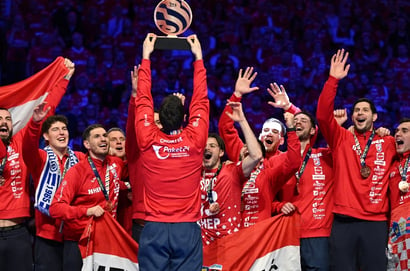
Denmark beat Germany 34-27 in the final in Herning in front of 15,000, having led 18-16 at half-time. It was Denmark's third continental title, sealed with eight wins from nine matches. Croatia took bronze 34-33 against Iceland. The semi-finals were Croatia 28-31 Germany and Denmark 31-28 Iceland, and Portugal beat Sweden 36-35 for fifth place.
The tournament produced 4,046 goals in 65 matches, an average of 62.25 per game. Shooting efficiency across the event was 64.7%, from 6,253 shots, up from 62% at EURO 2024. Mathias Gidsel set a tournament record with 68 goals from 95 shots at 71.6% efficiency, ahead of Simon Pytlick on 64 from 90 and Francisco Costa on 61 from 94. Denmark averaged 34.1 goals per 50 possessions and shot 71.1% from the field, among the highest figures recorded at a Men's EURO.
Recent EHF EURO Champions
Year
| Host(s)
| Winner
| Score
| Runner Up
| Third
|
|---|
| 2014 | Denmark | France | 41-32 | Denmark | Spain |
| 2016 | Poland | Germany | 24-17 | Spain | Croatia |
| 2018 | Croatia | Spain | 29-23 | Sweden | France |
| 2020 | Austria/Norway/Sweden | Spain | 22-20 | Croatia | Norway |
| 2022 | Hungary/Slovakia | Sweden | 27-26 | Spain | Denmark |
| 2024 | Germany | France | 33-31 | Denmark | Sweden |
| 2026 | Denmark/Norway/Sweden | Denmark | 34-27 | Germany | Croatia |
Titles by Nation
Nation
| Gold
| Silver
| Bronze
|
|---|
| Sweden | 5 | 1 | 1 |
| France | 4 | 0 | 2 |
| Denmark | 3 | 2 | 4 |
| Spain | 2 | 5 | 2 |
| Germany | 2 | 2 | 1 |
| Russia | 1 | 2 | 0 |
| Croatia | 0 | 3 | 4 |
Croatia's record is the outright market's cautionary tale: three silvers and four bronzes without a title. They reach the podium and lose the final.
Betting the EHF EURO
Outright winner. Six nations have won all 17 editions between them, and Sweden, France, Denmark, Spain and Germany account for 16 of them. Denmark, France and Sweden are the standing benchmark, Germany win when they host or come close, and Spain convert consistency into silver more often than gold. Backing outside that group requires a specific reason, not a price.
Preliminary round. Six groups of four with 24 teams means the quality gap is at its widest. This is handicap territory, and the lines run to double figures. France beat Ukraine 46-26 at EURO 2026, a 20-goal margin. Where the mismatch is extreme, the favourite's team total is the cleaner bet than the match total, because the underdog's suppressed score drags the combined figure around.
Main round. Carried-over points change intent match by match. A team that banked a big win in the preliminary round can rotate; a team behind on the table has to chase goal difference. Read the standings before the form guide.
Semi-finals and final. The margin compresses sharply. Across the 17 EURO finals, 47.1% were decided by one or two goals, with a mean margin of 4.47 and a median of 4. Three finals went to extra time — 2000, 2002 and 2024. Bronze medal matches are tighter still: Croatia won 34-33 in 2026 and Portugal beat Sweden 36-35 for fifth in the same tournament.
Totals. The 2026 average of 62.25 sits above the World Championship figure of 58.25 and just below the Champions League's 62.74. The highest total in 2026 was 84 goals in France 46-38 Portugal; the lowest was 47.