
Why Argentina's Choice Between Lautaro Martínez and Julián Álvarez Could Define World Cup Run

Riding a perfect start and with Messi topping the scoring charts, Argentina enters the World Cup round of 32 primed for success but faces a key selection question. Will coach Scaloni choose Lautaro Martinez’s structured, possession-heavy style, or Julián Álvarez’s high-energy pressing to break down Cape Verde’s disciplined low-block defense? The article recommends prioritizing Álvarez for his disruptive movement and pressing, giving Argentina the attacking edge needed to advance. This striker choice is likely to shape the outcome of the Miami knockout tie.
- Argentina topped Group J, Messi leads the Golden Boot race.
- Key tactical debate: Martínez's hold-up play vs. Álvarez's relentless pressing.
- Analysts favor starting Álvarez vs. Cape Verde’s low defensive block.
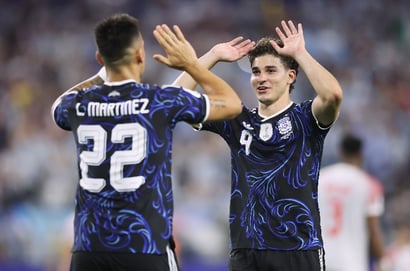
Following a flawless Group J sweep that culminated in a 3-1 victory over Jordan, Argentina head into the round of 32 with an ominous sense of rhythm.
Lionel Messi is leading the World Cup Golden Boot race with a tournament-high 6 goals, while the squad’s technical baseline looks entirely unbothered.
Yet, as Lionel Scaloni finalizes his preparations for the high-stakes clash against Cape Verde in Miami, an intense tactical debate is boiling over within the Albiceleste coaching staff.
Argentina’s center-forward selection is generally viewed as a simple luxury problem, with Lautaro Martínez and Julián Álvarez seen as interchangeable elite finishers who can be deployed on a whim.
However, a closer look at the opening three matchdays exposes a deep stylistic conflict. The decision of who anchors the central channel is not a cosmetic personnel swap but a fundamental choice between two entirely different tactical philosophies.
Choosing Lautaro's traditional positional restraint creates a specific, structural trade-off when compared with the direct pressing engine that Álvarez naturally provides.
Assessing the Difference Between Restraint and Pacing
The underlying difference between the two forwards rests on how their off-the-ball habits manipulate the opposition backline.
Martínez approaches the center-forward position as a clinical, positional anchor and is directed to stay pinned to the opposing center-backs, acting as a physical shield.
While this structural block offers a reliable focal point for Messi and Thiago Almada to bounce wall passes off of, it significantly alters Argentina's collective pacing.
Martinez operates with low-volume defensive pressures, preferring to save his metabolic energy for explosive movements inside the penalty box.
Conversely, Atlético Madrid's Julián Álvarez is a chaotic, front-footed disrupter. With Álvarez on the pitch, Argentina’s defensive line instantly shifts higher.
The Atletico Madrid forward does not wait for the ball to be recycled as he triggers immediate counter-pressing sprints that completely suffocate an opponent’s build-up play.
During his 82-minute starting shift against Jordan, Álvarez recorded an impressive number of defensive sprints. He hounded the center-backs and cut off horizontal passing channels before the opposition midfield could even turn to scan the pitch.
Facing Cape Verde’s Textbook Low-Block
Argentina are set to face Cape Verde’s textbook defensive low-block in the round of 16. The World Cup debutants fought their way through Group H via three rock-solid draws (including holding Spain to a 0-0 stalemate).
Bubista’s team relies entirely on compression, narrowing their back four and daring opponents to play predictable crosses from wide positions. This specific environment magnifies the choice between Argentina's two strikers:
Falling into Martinez’s Congestion Trap
If Scaloni starts Lautaro, Cape Verde’s defence will be handed exactly what they want: a stationary physical battle.
While Martinez’s ability to hold up play can create central link-ups for Messi, his lack of constant running lines allows Cape Verde’s defensive line to remain perfectly set.
Without a forward actively dragging defenders out of position with runs into the channels, the space right in front of the box becomes heavily congested, slowing Argentina’s transition tempo.
Unbalancing the Zonal Lines with Alvarez
Deploying Alvarez from the start can help stretch the Cape Verde backline. He systematically runs behind the full-backs, forcing the defensive line to drop deeper to respect his pace.
This movement pulls Cape Verde’s compact structure apart, opening up massive central shooting pockets for Messi and Alexis Mac Allister to exploit.
Furthermore, Alvarez’s relentless pressing would immediately target Cape Verde’s 40-year-old veteran keeper, Vozinha, forcing him into hurried, inaccurate clearances that put Argentina right back on the attack.
Scaloni’s Tactical Game Plan at Miami Stadium
Friday’s knockout clash between Argentina and Cape Verde at Miami Stadium will be decided by how Lionel Scaloni chooses to pace his team’s offense.
Sticking with Martínez offers a safe, possession-heavy structure that keeps the game under control, but it risks playing directly into Cape Verde's defensive plans by slowing down the tempo.
To truly dismantle a highly disciplined underdog before they can grow in confidence, Scaloni must consider unleashing his high-press approach from the start.
Prioritizing Alvarez’s relentless defensive work rate can help Argentina choke out Cape Verde’s outlet lines from the opening whistle, ensuring the world champions maintain a high-intensity pace that refuses to let the World Cup debutants breathe.
Top Betting Sites
Betting offers
Upcoming Events
10 June 2026
- Volleyball Nations League 2026 -
- Volleyball
11 June 2026
28 June 2026
Load More


